
Part I: The Quiet Start
Chetan Parikh’s story begins in a one-room home in Ahmedabad where his father sold newspapers at 3 in the morning and then worked a full shift in a textile mill by sunrise. His mother sold ghee from home to make ends meet. There was never any luxury, just enough to survive and a little more to dream.
“They never once let us feel poor,” Chetan says. “But I saw what dignity looked like when money was short.” That dignity became his inheritance.
Like most middle-class dreams in the 1970s, stability was the goal. A government job was security. So he took one, first at Ahmedabad Municipal Corporation, then at Gujarat Agro Industries Ltd. But even with a steady income, something inside him resisted routine and in 1983, he did something everyone told him not to do. He quit.
No savings cushion, no investors, not even a proper office. Just a diploma, two hands and an unshakable belief that he wanted to build something of his own. He started small with repairs, site supervision, odd projects that no one else wanted. Some months, he barely broke even.
By 1986, he had qualified as a civil engineer and officially launched Sarnar Buildtech, ‘Sar’ for Sardaben and ‘Nar’ for Naranlal, a tribute to the two people whose sacrifices were his foundation.
His first real project came three years after he started when Trivedi Marbles was relocating from Ambaji to Ahmedabad and needed someone to build a 60 by 60 feet shed for ₹5 lakhs. Every fifteen days the Trivedis visited, inspecting the site, noting his precision.
Then came an extension. Then another. Then the staff quarters. The foundation. The entire corporate campus. That one shed turned into a ₹20 crore relationship and it’s still alive, 33 years later.
When asked how he built his business, he laughs and says, “One honest square foot at a time.”
He never chased size or awards. He chased reliability. Because in his world, a foundation wasn’t just concrete. It was character.
Because for Chetan Parikh, business was never about scale. It was about staying. And the only way to stay, was to build like your own name was on every wall.
Part II: No Compromises, No Excuses
There’s a story that everyone at Sarnar Buildtech knows by heart. They had taken on a massive industrial project and halfway through, the client ran out of funds. His team panicked. “Sir, we’re not getting paid. Let’s stop,” they said.
Chetan didn’t even pause. “We committed,” he said. “So we finish.”
They used their own reserves to pay every labourer, every supplier and every bill on time.
Months passed but still, no payment came. And then, years later, that same client walked in, without any lawyer or reminder, just a handshake and a cheque. Full settlement.
That day taught him what no MBA could: Contracts don’t build trust. Character does.
And that’s been Sarnar’s operating code ever since. They don’t underbid. They don’t overpromise. They don’t take every job. They choose fewer projects and deliver every one as if it were their own.
Ask him about his team, and his tone softens. “One of my workers started here making tea, earning ₹250 a month. Today he earns a lakh.”
To him, loyalty works both ways.
Ask Chetan about awards or publicity and he waves it off. “We’re not building for headlines,” he says. “We’re building for people who will remember us ten years later.”
And that’s what separates builders from contractors.
One erects structures. The other builds trust that time cannot shake.
Part III: The Building He Can’t Rebuild
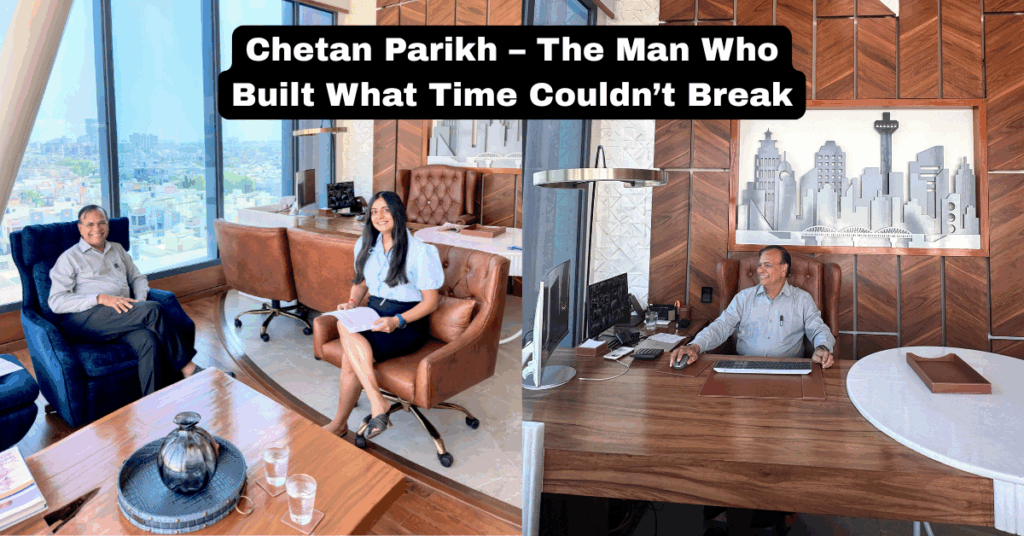
Chetan Parikh has built factories, townships, and offices across India. But there’s one building he can’t look at without a lump in his throat: his seven-storey Sarnar headquarters.
It’s the one his son, Dhruvil Parikh, designed.
Dhruvil was everything a next generation entrepreneur should be: grounded, globally educated and quietly visionary. After studying in the US and UK, he returned to Ahmedabad, then expanded the business to Dubai.
“He had the eye of an architect and the discipline of an engineer,” Chetan says. “But most of all, he had heart.”
When they began planning the new office, Dhruvil told him, “Papa, we’re not just builders. Let’s build something that reflects who we are.”
That building became his canvas. Dhruvil led everything from design and systems to structure, efficiency and finish. He trained workers himself. Walked every floor. Checked every line. He wanted every square foot to mean something.
And it does.
Because just months after completing it, Dhruvil was gone.
COVID brought him back to Ahmedabad and then, cruelly, took him away.
No father is built to survive that sentence.
“He was my only son,” Chetan says softly. “My successor. My pride. My friend.”
But even in his absence, Dhruvil left behind something that couldn’t be broken, his work.
Every morning, when sunlight floods the atrium of Sarnar’s headquarters, it feels like he’s still there in the symmetry, in the precision, in the stillness of the structure he imagined.
“That building,” Chetan says, “is the one thing I can’t rebuild. And the one thing I’ll never need to.”
The team Dhruvil trained still works there. The systems he built still guide them. And the company keeps moving forward, one project, one beam, one quiet morning at a time.
“People think business is about profit,” Chetan says. “For me, it’s about presence.”
Because his son may not be here.
But his values: precision, humility and honesty still lead every project, brick by brick.


