
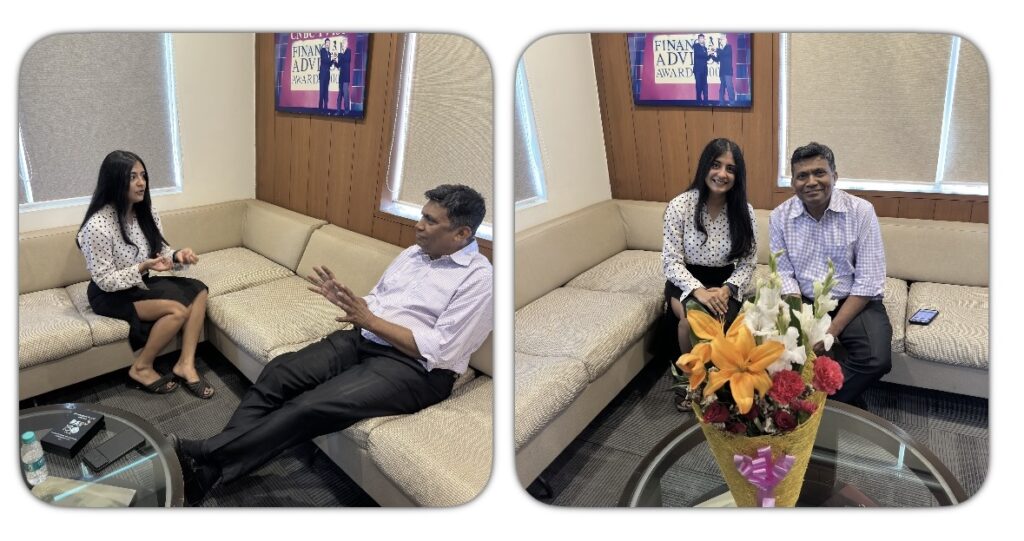
Part 1: The Petrol Pump Lesson
Ashish Shah started his story in a place that, at first, sounds wrong for a future money-man: a Bandra petrol pump at the Turner Road junction. He tells me how after engineering he joined HPCL, not for passion, but for experience and security. He continues telling me how the job put him on the last mile of a huge industrial pipeline, “At a petrol pump,” he says quietly, “you learn what service really is.”
He tells me what happened there like a lesson taught by grit. A customer arrives, the attendant opens the bonnet, checks the oil, the radiator, the wipers, wipes the windscreen and thanks the motorist as they leave. No one paid extra for it, but the station that did this consistently, every single day, won loyalty that money couldn’t buy.
That was his first class in customer economics: service builds repeat business and repeat business builds goodwill.
But he wanted more than security. He wanted to build something of his own. So, after a few years, he took his first risk: a short-lived water purification venture with a friend. It lasted barely six months before folding up. Soon after, he started what would one day become Wealth First Portfolio Managers Ltd.
He didn’t arrive with a big brand or easy money. He arrived with the discipline he learned at the pump: show up, do a little more than you promised and care about the person across the counter. And, lest we forget, the will to get business from wherever possible. He started scanning local newspapers, looking for companies that were hiring. If a company was recruiting, it probably had surplus funds. Those were his leads and his first marketing strategy. It worked.
Part 2: Will the Customer Come Back Tomorrow?
He tells me about the early days of Wealth First like someone explaining a long problem they learned to solve day by day. There was no glamour, just small breaks, one client at a time and endless repetition. The financial market kept changing its rules and is constantly hit with crises, regulation and product innovation and he learned to make a business that survived by being steady.
He became a student of bonds and fixed income because he saw two things: ordinary savers need predictability and institutions respect structure. So he built products around what people could understand: time (duration), return (yield), risk (credit risk) and he taught them how these things mattered. He tells people plainly: “We don’t peddle stories or chase targets, we explain math and behaviour.” That bluntness turned into credibility.
Slowly, the shop grew. By the early 2000s, Wealth First began creating ripples in Gujarat’s financial circles. It became one of the first firms in the region to structure ₹1 crore bond deals, sell zero-coupon bonds and act as a market maker for mutual fund schemes like UTI Unit 64.
He says this phase was possible only because of two people – his wife, Henna and his friend.
“Henna handled the home front without a single complaint,” he said quietly, “so I could handle the business front.” It was the kind of unseen partnership that doesn’t make headlines but makes history. And on the professional side, he had a friend who believed in his conviction just enough to build with him when few others did.
Ashish built Wealth First Portfolio Managers Ltd. brick by brick, sometimes literally. Being a market-maker in bonds, he placed big, quiet bets focusing on tax-efficient instruments, offering products that looked boring but worked. The company IPO’d and opened itself to public scrutiny because he wanted the accountability of being a listed firm, not just private applause.
Here’s the lived tension: he could’ve chased the flashier fee streams, brokered bigger, riskier products. Instead he doubled down on being explainable and dependable. People who sat across from him in those early years describe him as the man who treated client money like a ledger to be honored.
Will the customer come back tomorrow?
That curiosity about service becomes the secret architecture of Wealth First.
Part 3: The Quiet Scale: Metrics, Mission and the Next Problem
Today, Wealth First has become a scaled, public company offering advisory, mutual fund distribution, PMS and more, with steady top-line growth and a disciplined product mix. The business he built is not headline splash, but something sturdier with recurring revenues, advisory fees and client relationships that compound like SIPs. Recent investor materials show continued revenue growth and the firm’s focus on advisory income as a durable base.
Recent investor materials show continued revenue growth and the firm’s focus on advisory income as a durable base. But he doesn’t ask me to celebrate the numbers. He wants to talk about the next problem: how to teach a new generation to save the right way and how to make complex instruments simple without dumbing them down.
He worries about technology, not as threat, but as magnifier. “If AI gives people attention, we must give them judgment,” he says. His work now is less about selling products and more about curating a life-long saving habit for clients who never thought finance could be human.
And just as quietly, he reveals what comes next. After years of building credibility in advisory and distribution, Wealth First has now floated its Asset Management Company named Lakshya Asset Management and is now on the verge of receiving its license to launch its own mutual fund, which is a milestone that marks the highest point in its non-fund-based journey so far. “It feels like a natural evolution,” he says. “From advising on funds to finally building one of our own.”
It’s not a move driven by ambition alone, but by decades of understanding investors, cycles and the patience required to build something lasting.
He closes the conversation the way he began it, with a small scene: the fan, the phone and the tea cups. He says: “When we grow, I still want to be remembered as the person who taught clients to behave, not to speculate.” That’s the quiet ambition, to make the financial lives of ordinary people less accidental and more intentional.


